Holographic Effective Medium Theory
Understanding the anomalous transport properties of strange metals—such as those found in high-temperature superconductors—remains one of the central open problems in condensed matter physics. Holographic duality, originally developed in high-energy physics, can offer insights into these systems. By combining holographic models with ideas from effective medium theory (EMT), we investigate how nanoscale spatial inhomogeneity might influence the macroscopically observable transport properties such as the magnetoresistance.
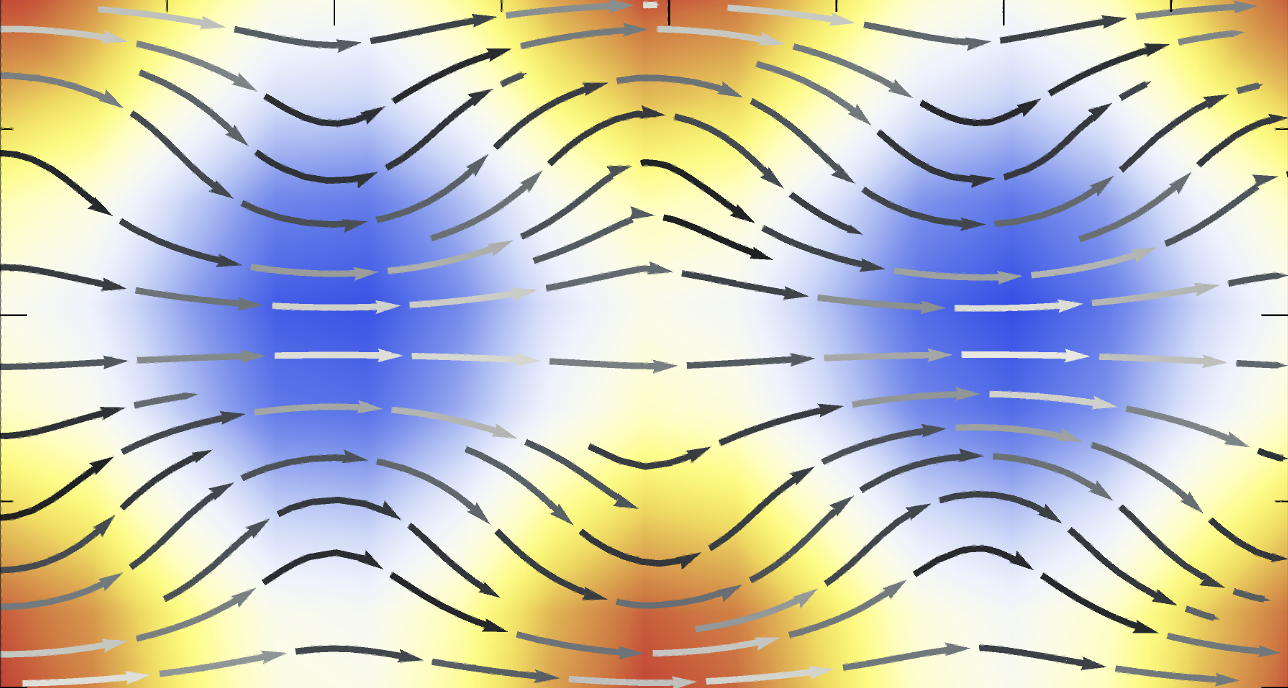
In particular, we studied a quantum critical system subject to a spatially varying chemical potential, in the limit of strong translational symmetry breaking, and found that for 2D lattices, an “EMT” regime emerges naturally (Nilsson & Schalm, 2025). The electrical conductivity increases, as the current is able to take a curved path of least resistance through the potential landscape. This has implications for the magnetotransport, which exhibits a roughly B-linear dependence as seen in explicit EMT constructions. Furthermore, although our model has no coherent (Drude) conductivity on average, we observe the emergence of local Drude-ish hydrodynamics in each potential “pocket”, such that the total AC response exhibits typical “bad metal” behavior with a broad Drude peak.