2D Fermi Liquids
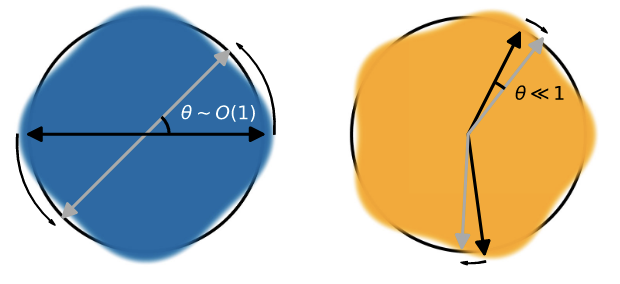
In clean, two-dimensional materials, the electrons can reach a hydrodynamic transport regime, flowing around obstacles like water. However, the kinematics of electrons in 2D are heavily constrained by the scattering phase space set by the Fermi surface. By expanding Fermi surface deformations into angular harmonics, one may classify that even-parity deformations can decay through head-on collisions, leading to a standard Fermi liquid decay rate $\gamma_{\text{even}} \sim T^2/T_F$. Odd-parity deformations instead have to rely on repeated small-angle scattering events assited by the thermal broadening, leading to a thermally supressed decay rate $\gamma_{\text{odd}} \sim T^4/T_F^3$.
That odd and even Fermi surface deformations relax on parametrically different timescales hints at the existence of a novel transport regime in between ballistic and hydrodynamic flow: a “tomographic” regime, consisting of hydrodynamic modes, in addition to the long-lived odd-parity modes.
Together with my collborators we have detailed a method of exactly diagonalizing the collision integral in the Boltzmann equation, including the effects of the Coulomb interaction between the electrons (Nilsson et al., 2025). This allowed us to completeley characterize the mode spectrum, and we found that the odd-parity effect in the decay rates extends to temperatures as large as $T = 0.15 T_F$. Furthermore, there is only a small number of long-lived odd-parity modes, with an infinite number of remaining modes that show standard Fermi-liquid scaling, and the ratio between the odd- and even-parity lifetimes is tunable with the Coulomb interaction strength.
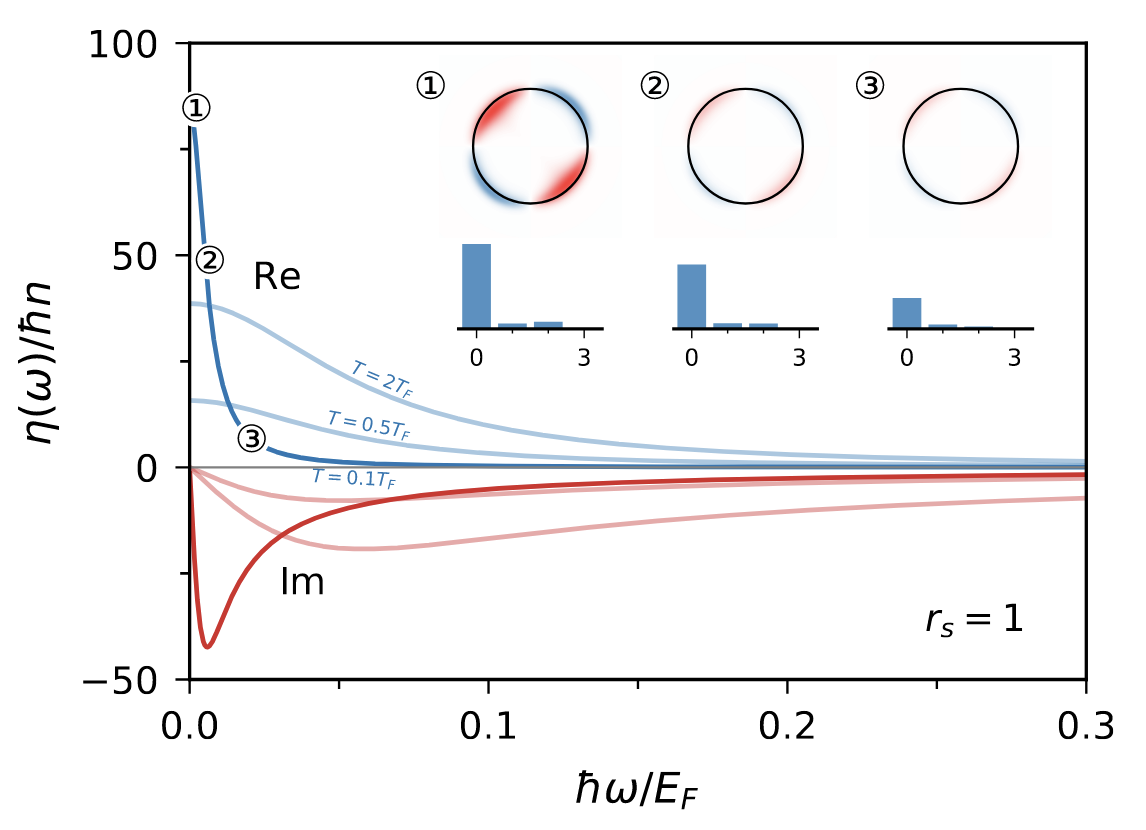
We also applied the results of the exact diagonalization to compute transport coefficients; in particular the shear viscosity (Gran et al., 2023). Valid at all temperatures, we are able to describe the response beyond the asymptotic low-temperature limit, where perturbative approaches exist. Even in this low-temperature limit, there is a nonanalytic exchange contribution to the shear viscosity, highlighting the need for a full nonperturbative solution of the Fermi liquid equation.